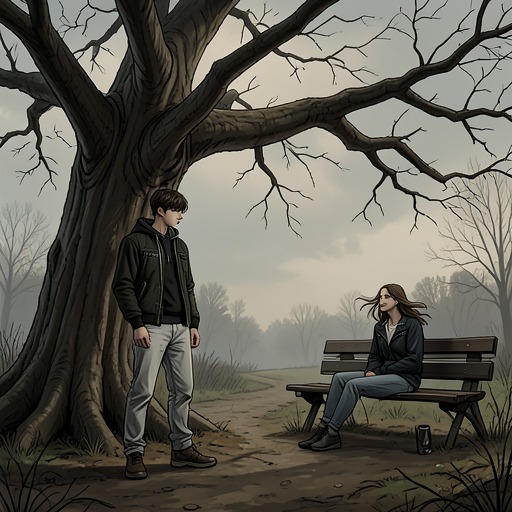
The Oak
𝐋𝐚𝐜𝐮𝐧𝐚 | 𝑱𝒆𝒐𝒏 𝑱𝒖𝒏𝒈𝒌𝒐𝒐𝒌The Oak is an Ellensburg bar whose importance comes less from its ordinary function than from the crises it contains and releases. It first appears as a place where Jungkook tries to drown his emotions in whisky, then becomes the setting for his violent confrontation with Dong-hyun. The bar therefore operates as a threshold: inside, an employee recognizes the danger of uncontrolled drinking and urges retreat; outside, the same emotional pressure erupts into a public assault that summons law enforcement.
Setting and Function
The Oak is identified as an Ellensburg establishment with a wooden counter, a bartender, and customers being served during the evening. The scene is marked by a precise time, 21:22, placing the location within the book's chronological, contemporary setting rather than treating it as an abstract backdrop. Its everyday commercial atmosphere contrasts with Jungkook's increasingly unstable condition: the bar continues to function normally while his emotional state threatens to turn the room into the beginning of a fight.
The bartender has seen many people attempt to drown their feelings in alcohol, but he regards Jungkook's emotions as especially alarming because the young man appears close to triggering a confrontation. This observation gives The Oak a limited but significant social conscience. It is not presented as a place that solves suffering; it is a place where suffering becomes visible to another person before it becomes physically destructive.
Jungkook's Drinking and the Attempted Intervention
Jungkook consumes a sixth glass of whisky and immediately begins a seventh, swallowing it in one motion before placing the glass hard on the wooden counter. The sequence makes the bar's objects register as evidence of escalation: the repeated glasses, the abrupt gesture, and the bartender's worried attention turn ordinary drinking into a warning pattern. Jungkook's intoxication is not merely recreational in this scene; it is the method he uses to suppress emotions that remain active beneath the alcohol.
The bartender approaches him from behind the counter and advises him that alcohol cannot solve his problems. He recommends that Jungkook go home and rest. Faced with this direct but nonviolent intervention, Jungkook gives in, pays his bill, puts on his jacket, and leaves The Oak. The immediate value shift is from possible disorder to temporary withdrawal. The intervention succeeds in getting him out of the bar, but it cannot remove the source of his anger waiting outside.
The Confrontation Outside the Bar
Outside The Oak, Jungkook sees a car he knows and immediately regrets leaving the establishment. Dong-hyun is there, and recognition transforms Jungkook's subdued exit into renewed rage. His anger rises through physical signs of tension: he closes his fists, contracts his muscles, and clenches his teeth. The public space outside the bar becomes the point at which an internal family history becomes an observable conflict.
Dong-hyun approaches the entrance, bumps his younger son with his shoulder, and comments on Jungkook's smell of alcohol. The encounter carries both present hostility and the weight of their violent father-son relationship. Jungkook seizes Dong-hyun by the jacket and turns him toward himself. When Dong-hyun continues to provoke him, Jungkook attacks, striking his father repeatedly and tightening his grip around his throat as his rage intensifies.
The narration frames Jungkook's aggression through the recurring image of demons sitting on his shoulders and feeding on the spectacle of revenge. In relation to The Oak, that image turns the doorway into a symbolic boundary between restraint and surrender. The bartender's advice has briefly interrupted the cycle, but Dong-hyun's appearance reactivates it, and the bar's immediate surroundings become the arena in which Jungkook reverses the helplessness associated with his father by physically overpowering him.
Witnesses and Consequences
The bartender notices the fight through the window while continuing to serve customers. He abandons what he is holding, goes outside, and attempts to pull Jungkook away. He cannot stop the assault and ends up on the ground, exhausted. The failed intervention changes the nature of the scene: the conflict is no longer private or containable, and the ordinary worker who tried to prevent escalation becomes an endangered witness within it.
With physical intervention unsuccessful, the bartender calls the 911. The emergency call is the immediate consequence of the violence at The Oak and establishes the location as the point from which the family conflict enters public and institutional response. The bar thus links three forms of action in sequence: drinking as avoidance, confrontation as eruption, and emergency reporting as the first external limit placed on Jungkook's violence.
Narrative Significance
The Oak's narrative significance lies in its double role as refuge and threshold. Jungkook enters it while attempting to manage distress through alcohol; the bartender's concern recognizes that this strategy is failing, yet the more decisive trigger is outside the building, where Dong-hyun's presence exposes the unresolved source of Jungkook's anger. The contrast between the bartender's measured counsel and Jungkook's later assault sharpens the difference between support that invites withdrawal and trauma that demands confrontation.
The location also gives the conflict a social audience. The wooden counter, the bartender, the customers, the window, and the entrance all transform Jungkook's emotional collapse into an event observed by others. What begins as an individual attempt to numb pain ends with a witness, a failed attempt at restraint, and a call for emergency assistance. In that progression, The Oak becomes one of the book's clearest spaces of transition from inward suffering to outward consequence.